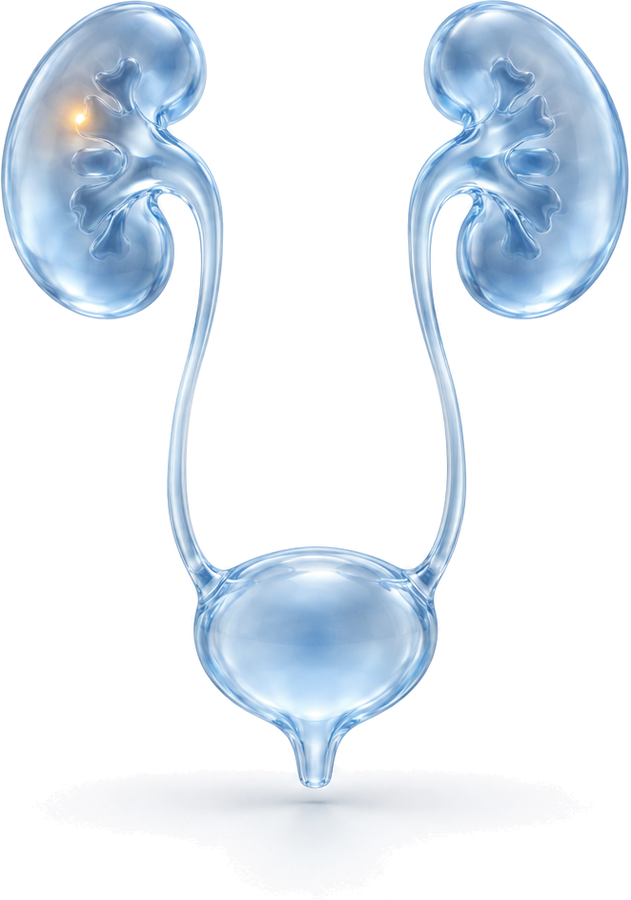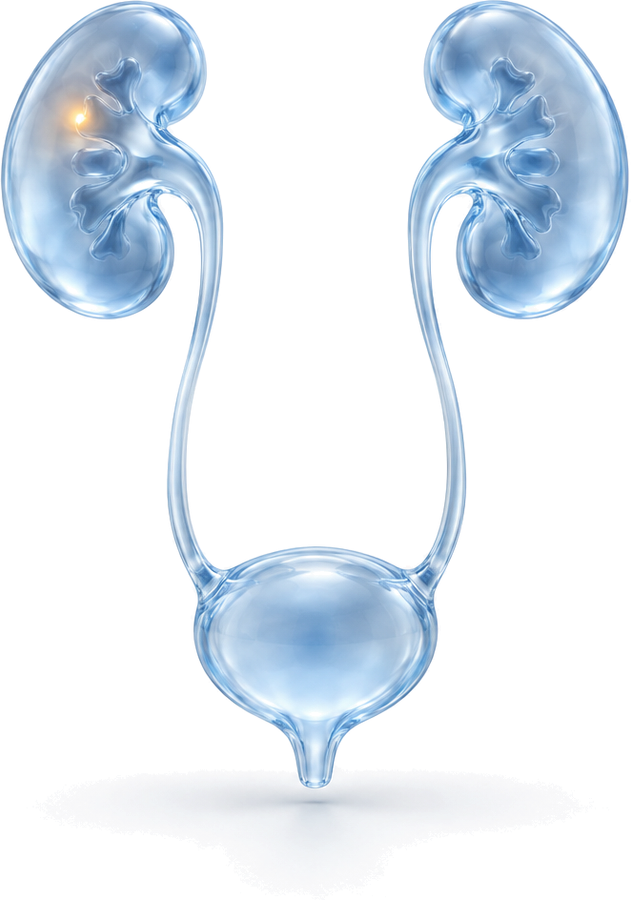
What is bladder cancer?
Bladder cancer is a malignant tumour that develops from the cells lining the inside of the bladder, the sac where urine is stored. Most cases arise from the urothelial cells that form this inner lining, which is why it is also called urothelial carcinoma. It is more common in men than in women and usually occurs after the age of 60. Although rarer, it can also occur at a younger age.
The most important factor in deciding treatment is how deep the tumour has grown into the bladder wall:
- Non-muscle-invasive (superficial) bladder tumours: Most patients are in this group at diagnosis. The tumour can be removed endoscopically and the bladder is preserved.
- Muscle-invasive bladder tumours: The tumour has reached the muscle layer of the bladder. More extensive treatment is needed.
Risk factors
Smoking is the most important known risk factor for bladder cancer. Carcinogens from cigarettes are excreted in the urine and stay in contact with the bladder wall for long periods. Stopping smoking reduces the risk over time and is also recommended for patients who are being treated.
Other risk factors include:
- Long-term exposure to aromatic amine chemicals in certain occupations, such as the dye, rubber, leather and chemical industries
- Previous radiotherapy to the pelvic area
- Certain chemotherapy drugs
- Older age and male sex
Symptoms of bladder cancer
The most common and most important symptom is painless blood in the urine (haematuria). The urine may turn pink, red or cola-coloured. The bleeding may appear once and then disappear for days or even weeks; this does not mean the problem has gone away. Sometimes the blood is not visible and is detected only in a urine test.
Less commonly, the following symptoms may also occur:
- Frequent urination and a sudden urge to urinate
- Burning when passing urine (without an infection)
- Flank or groin pain in advanced stages
Most of these symptoms can also occur with more common conditions such as a urinary tract infection or an enlarged prostate. This is why a planned urological assessment, rather than panic, is the right approach.
How is it diagnosed?
- Urine test and urine culture: Confirm the presence of blood and rule out infection.
- Urine cytology: The urine is checked for cancer cells; this is particularly helpful in detecting high-grade tumours.
- Imaging: Ultrasound may be the first step. For patients with visible blood in the urine, CT urography is generally recommended to assess the kidneys and ureters as well.
- Cystoscopy: The inside of the bladder is examined directly with a thin camera passed through the urethra. It is the key method for diagnosing a bladder tumour and is usually done with a local anaesthetic gel.
Bladder cancer treatment
Treatment is planned individually, taking into account the depth, grade, number and size of the tumours and the patient’s general health.
TURBT (endoscopic bladder tumour surgery)
The first surgical step for a bladder tumour is usually transurethral resection of bladder tumour (TURBT). Under spinal or general anaesthesia, the tumour is removed from the bladder wall with an endoscope passed through the urethra. There is no incision in the skin. TURBT serves both diagnosis and treatment: pathological examination of the removed tissue shows the type and grade of the tumour and whether it has reached the muscle layer. Some patients may need a second check resection (re-TURBT) a few weeks later.
Intravesical treatments (BCG and chemotherapy)
For non-muscle-invasive tumours, medication can be given into the bladder to reduce the risk of recurrence and progression:
- Single-dose intravesical chemotherapy: Can be given shortly after surgery for low-risk tumours.
- BCG therapy: Preferred for intermediate- and high-risk tumours. An initial course of usually six weekly instillations is followed by maintenance doses lasting from months to years, depending on the risk group.
These treatments are given into the bladder through a thin catheter, as an outpatient procedure. Temporary burning when passing urine and frequent urination are common side effects.
Radical cystectomy and reconstruction of the urinary tract
For muscle-invasive tumours and some high-risk tumours that do not respond to intravesical treatment, radical cystectomy, the removal of the bladder together with the surrounding lymph nodes, is considered. In suitable patients, chemotherapy before surgery is recommended. Once the bladder has been removed, a new route for urine is created (urinary diversion):
- Ileal conduit: Urine is carried through a short channel made from bowel to an opening in the skin of the abdomen and into an external bag.
- Orthotopic neobladder: In suitable patients, a reservoir made from bowel is connected to the urethra, and urine is passed in the usual way.
In selected patients, bladder-sparing treatment combining TURBT, chemotherapy and radiotherapy may also be an option. In advanced disease, treatment is planned together with medical oncology and radiation oncology.
After treatment and possible risks
After TURBT, the urinary catheter is usually removed within a few days, and patients go home soon afterwards. Mild blood in the urine and burning may occur in the first days; drinking plenty of fluids helps during this period. Rarely, complications such as bleeding after surgery or perforation of the bladder wall may occur; these are usually managed by leaving the catheter in for longer.
Temporary side effects such as burning when passing urine, frequent urination and a mild fever are common with intravesical BCG treatment. If high fever, chills or fatigue lasting more than a few days develop, inform your doctor without delay.
Radical cystectomy is a major operation, and the hospital stay is longer. Before surgery, caring for the new urinary route, nutrition and the recovery process are discussed in detail with the patient and their family; preparing the patient for this process makes recovery easier.
Follow-up after treatment
Because non-muscle-invasive bladder tumours can tend to recur, regular follow-up is an essential part of treatment. The first check cystoscopy is usually carried out about 3 months after TURBT. The frequency of later check-ups depends on the risk group:
- For low-risk tumours, check-ups are carried out at longer intervals.
- For high-risk tumours, cystoscopy and urine cytology are carried out about every 3 months in the first years; the intervals are then gradually extended. Imaging of the kidneys and ureters at set intervals is also recommended.
If you notice blood in the urine again during follow-up, see your doctor without waiting for your next scheduled check-up. Stopping smoking remains the most important lifestyle change recommended during follow-up.
Bladder cancer treatment in Bursa, Turkey
Op. Dr. Mücahit Kabar graduated from Uludağ University Faculty of Medicine and completed his urology residency at the Urology Clinic of Ankara Training and Research Hospital. He is a member of the Eurasian Uro-Oncology Association and has a scientific publication describing a rare case of urothelial bladder cancer in an 18-year-old patient. He sees patients with blood in the urine and suspected bladder tumours in Bursa (Nilüfer) at Özel Medicabil Nilüfer Hastanesi (weekdays 08:30–12:00) and Özel Jimer Hastanesi (weekdays 13:00–17:00).
Consultations are held in English or Turkish. The hospitals’ international patient departments can arrange interpreters for other languages and help with airport transfers and accommodation. If you are travelling from abroad, you can book your appointment in advance through the online booking page or appointment line of Özel Medicabil Nilüfer Hastanesi (weekdays 08:30–12:00, +90 444 8 112) or Özel Jimer Hastanesi (weekdays 13:00–17:00, +90 444 45 67). You can share your imaging, cystoscopy or pathology reports beforehand via WhatsApp (+90 541 622 54 82). More information is available on the international patients page and the contact page.